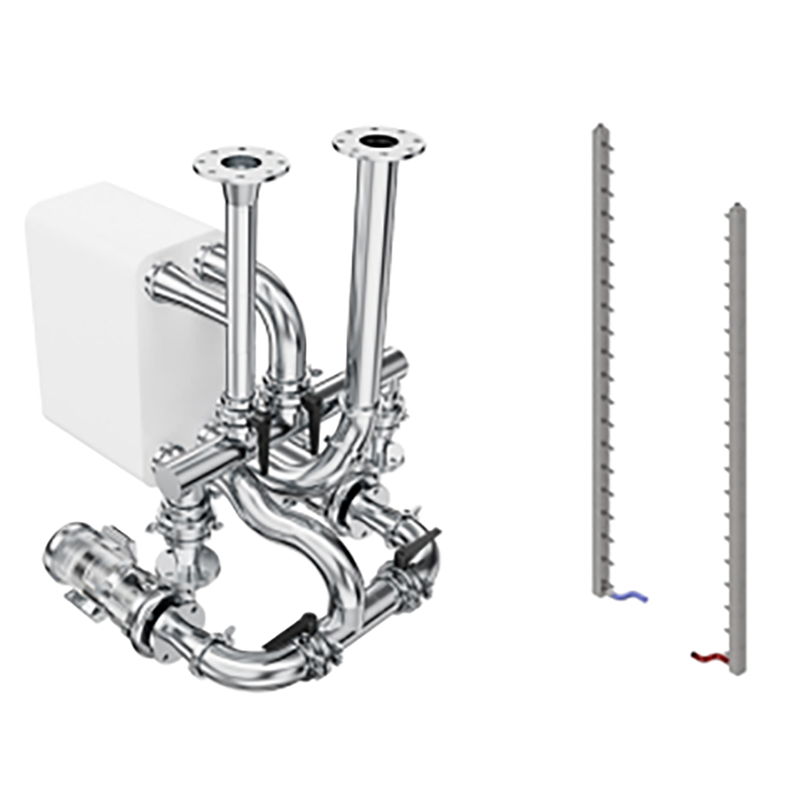
Stainless steel sanitary tubing is a high purity piping solution specifically engineered for industries where cleanliness and sterilization are paramount. Unlike standard industrial pipes, these tubes feature an ultra-smooth internal bore to prevent bacteria growth and product buildup. They serve as the critical infrastructure for fluid transport in the food and beverage, dairy, brewery, biopharmaceutical, and cosmetic industries.
We provide a full portfolio of sanitary tubing compliant with major global hygienic specifications. This includes the European DIN 11850 and EN 10357 series (Series A, B, C, and D), as well as the American ASTM A270 and 3A standards. We also support ISO 2037 and SMS 3008 for international system compatibility. Our size range covers OD 1/2 inch to 12 inch and DN10 to DN300, matching most global valve and fitting systems.
Quality begins with the right alloy. Our tubing is primarily manufactured from 304 and 316L austenitic stainless steel. 304 is ideal for standard food grade applications, while 316L (containing Molybdenum) is the preferred choice for pharmaceutical and acidic environments due to its superior resistance to pitting and chemical cleaning agents. Every order is delivered with an EN 10204 3.1 Mill Test Certificate (MTC) to ensure full material traceability and compliance with FDA and GMP requirements.
---
We offer both welded sanitary tubing and seamless sanitary tubing to meet various pressure and safety needs. Our welded tubes utilize automated TIG or Plasma technology with internal weld bead leveling to ensure a crevice-free interior. For advanced projects, we strictly control the sulfur content (0.005 percent to 0.017 percent) to optimize automated orbital welding performance, providing high-quality and contamination-free joints during field installation.
Surface integrity is the most vital technical indicator for hygienic engineering. We strictly monitor internal roughness to meet ASME B46.1 and DIN requirements. Standard internal surfaces reach Ra 0.8 μm or Ra 0.5 μm. For high purity applications, we provide Electropolished (EP) tubing with a finish of Ra 0.38 μm or better. We also offer Bright Annealing (BA) and various mechanical polishing options to support efficient CIP (Clean-in-Place) and SIP (Sterilize-in-Place) processes.
To guarantee zero-defect delivery, every tube undergoes a rigorous inspection protocol. This includes 100 percent Eddy Current Testing, hydrostatic pressure tests, and dimensional verification. We also perform 100 percent Borescope inspection to confirm the perfection of the internal weld and surface. As a total solution provider, we also supply matching sanitary elbows, tees, and reducers to help you build a complete and reliable hygienic piping system.
Stainless steel tubing is an important component of liquid processing systems. This accessory transports beverages and other fluids from one place to another without corroding or contaminating your product. Our stainless steel tubing is easy to dismantle and clean.
At CSI, we research the quality of each product so you don't have to. That is why we only stock tubing made out of the highest-quality alloys. If your tubing must withstand high acidity or high purity applications, choosing our long-lasting piping will prevent replacement downtime for your equipment.
Our tubing made out of 304 stainless steel best suits industries like the dairy, brewery, and food-processing industries. Although this material is best known for its durability and resistance to corrosion, it is susceptible to damage from acidic material and highly concentrated saline.
AI clusters use aggressive Deionized (DI) water. Our TP316L tubing, with 2% Molybdenum, offers superior resistance to ionic leaching. This maintains low fluid conductivity and protects multi-million dollar GPU assets from electrochemical corrosion.
Smoother walls (our Ra ≤ 0.4μm finish) reduce friction and pressure drop. This allows pumps to operate with less energy, directly lowering PUE and supporting green energy goals.
Our Online BA process at 1040°C+ restores the metallurgical structure and eliminates welding stress. This prevents Stress Corrosion Cracking (SCC) over 15+ years, ensuring the piping remains leak-free.
Manifolds connect to Quick Disconnects (QDs). Our precision ±0.05mm tolerance ensures perfect O-ring compression, allowing "hot-swapping" of servers with zero risk of leakage.
Residual oils contaminate coolants and clog micron-sized channels in server cold plates, causing "Hot Spots." We perform electronic-grade degreasing to ensure zero organic residue.
Water tests find cracks; our Helium testing finds molecular-level leak paths. For high-asset AI clusters, we provide leak rates ≤ 1x10⁻⁸ mbar·l/s, offering much higher security.
Cold Plate systems demand precision OD and purity (EP/BA). Immersion systems require extreme chemical stability as they stay submerged. We offer customized passivation for both architectures.
Adhering to ASTM A270/ASME BPE, our tubes have a service life of 15+ years, matching the facility's lifecycle and reducing Total Cost of Ownership (TCO).
Our pre-fabricated manifolds reduce on-site welding and contamination. Using automated orbital TIG welding, we ensure high-precision branch positioning and faster facility deployment.
Yes. Our production and QA systems are fully compliant with ASME BPE and 3A Sanitary Standards. Every batch comes with Material Test Reports (MTR) for full traceability.